Bed Frames and Foundations, Decoded
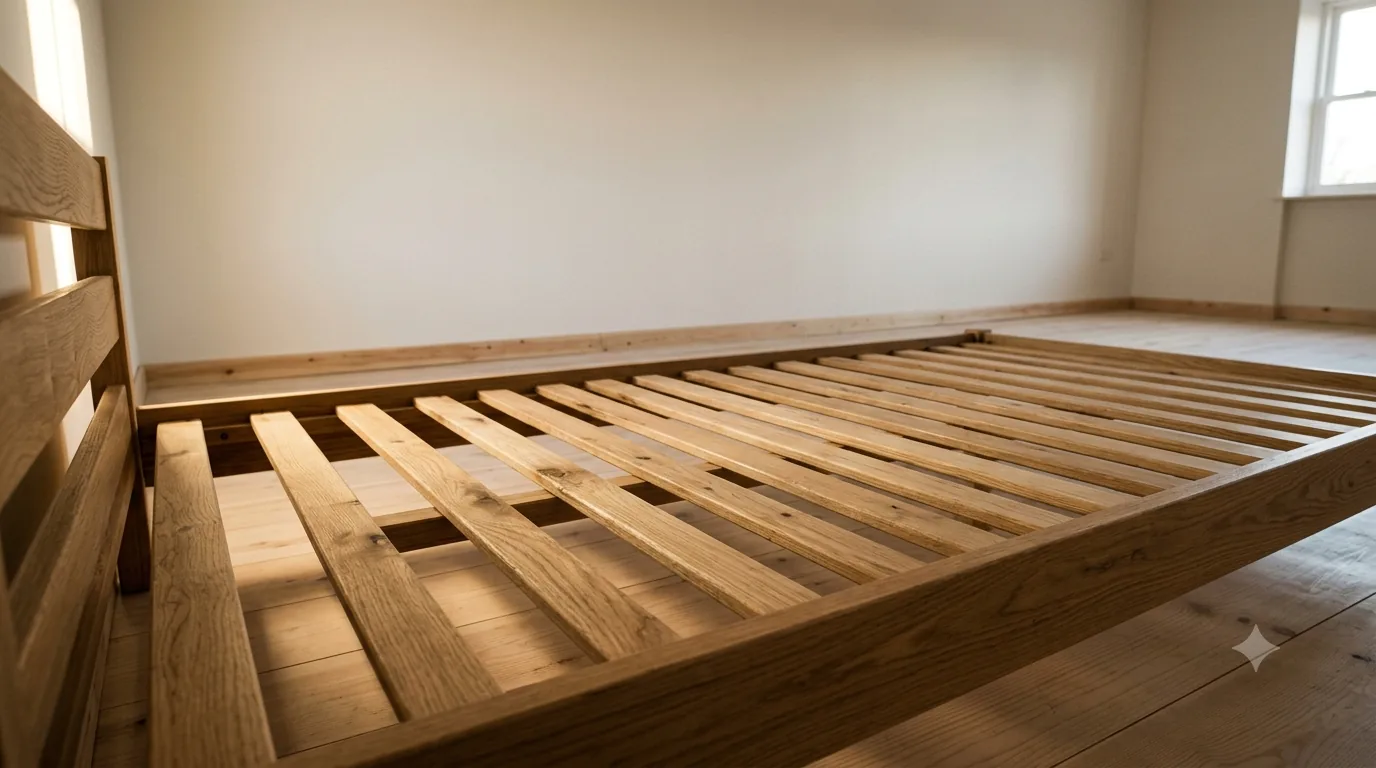
The frame spec most likely to cost you money is slat spacing. Most foam mattress warranties require a maximum gap of about 3 inches. Exceed it and the foam sags into the openings — and the manufacturer can classify that as improper support and decline the claim. Meanwhile any bed wider than a twin needs a centre rail with legs to the floor.
The one thing to know: Slat spacing is the single specification most likely to void a mattress warranty. Most foam and memory-foam mattress warranties specify a maximum slat gap of about 3 inches, and some require 2.5 inches for thicker foam builds. Wider gaps let the foam sag into the openings over time, and manufacturers commonly list that as "improper support" — grounds to deny a warranty claim on a mattress that failed exactly as the frame allowed it to.
Start with the data
- The Slat Spacing & Warranty Index — maximum gap by mattress type and what exceeding it does.
- The Bed Size & Support Index — all six standard sizes and which need centre support.
- Key facts — the short version.

Platform frames
Zinus Metal Platform Bed Frame with Closely Spaced Slats
Steel platform frame, closely spaced steel slats, no box spring required
Steel slats spaced for foam mattresses, which is the spacing most foam warranties require.
Best for: Foam and hybrid mattresses without a separate foundation
Watch out: Confirm the listed slat gap for the exact model and size before buying - spacing can differ between sizes in the same product line, and the warranty requirement is on you to meet.
Check price on AmazonNot deciding today? Add it to your cart over there — Amazon keeps it saved (and flags any price change) until you're ready.
Zinus Wood Platform Bed Frame with Centre Support
Wood slat platform, centre support rail with legs, no box spring required
Ships with the centre rail and legs that queen and larger sizes actually require.
Best for: Queen and larger foam mattresses
Watch out: Wood slats vary in thickness between models; a thin slat on a wide span can still bow even when the spacing is correct.
Check price on AmazonNot deciding today? Add it to your cart over there — Amazon keeps it saved (and flags any price change) until you're ready.
Foundations and bunkie boards
Zinus Rigid Mattress Foundation (low profile)
Rigid wood/metal foundation with fabric cover, low profile height
A rigid, non-flexing base, which is what foam mattress warranties generally call for rather than a box spring.
Best for: Foam mattresses that need a foundation inside an existing frame
Watch out: A foundation is not a box spring and does not flex - if your mattress warranty specifically requires a box spring, this is the wrong product.
Check price on AmazonNot deciding today? Add it to your cart over there — Amazon keeps it saved (and flags any price change) until you're ready.
Any brand Bunkie Board
Thin rigid board placed over existing slats
A cheap way to close excessive slat gaps on a frame you already own without replacing it.
Best for: Fixing a frame whose slat spacing exceeds the mattress warranty limit
Watch out: It adds height and does not fix a frame that is structurally sagging or under-supported in the centre - it only addresses gap width.
Check price on AmazonNot deciding today? Add it to your cart over there — Amazon keeps it saved (and flags any price change) until you're ready.
Support parts and retrofits
Any brand Adjustable Centre Support Legs
Adjustable-height steel support legs with non-slip base, per-leg capacity stated by vendor
Adds the centre support that queen and larger frames require, on a frame that shipped without enough.
Best for: Retrofitting an under-supported queen, king or California king frame
Watch out: Per-leg capacity figures vary widely by vendor and are often stated without a test standard - check the specific listing rather than assuming a category figure.
Check price on AmazonNot deciding today? Add it to your cart over there — Amazon keeps it saved (and flags any price change) until you're ready.
Any brand Replacement Bed Slats
Wood or steel replacement slats, sold by size and count
Lets you close slat gaps to the roughly 3-inch maximum most foam warranties require.
Best for: Frames whose original slat spacing is too wide for a foam mattress
Watch out: Adding slats narrows the gaps but does not increase the frame's weight capacity or add centre support.
Check price on AmazonNot deciding today? Add it to your cart over there — Amazon keeps it saved (and flags any price change) until you're ready.
Common questions
Frequently Asked Questions
Slat spacing is the single specification most likely to void a mattress warranty. Most foam and memory-foam mattress warranties specify a maximum slat gap of about 3 inches, and some require 2.5 inches for thicker foam builds. Wider gaps let the foam sag into the openings over time, and manufacturers commonly list that as "improper support" — grounds to deny a warranty claim on a mattress that failed exactly as the frame allowed it to.
Yes, provided the gaps meet the mattress warranty requirement - generally about 3 inches maximum, and sometimes 2.5 inches for thicker foam builds. Wider gaps let the foam sag into the openings and are commonly treated as improper support.
A bunkie board or additional replacement slats will close the gaps without replacing the frame. Neither fix adds centre support or increases the frame's weight capacity, so check those separately.